
Monroe County Deed Types
The Monroe County Clerk of Superior Court records land instruments. The deed records index names the parties and points to a filed document. The instrument type, however, controls what actually happened. A warranty deed is not a quitclaim deed.
Always read the document itself and its legal description before adding it to an ownership chain. The index alone cannot tell you that.
| Deed Type | What It Does | Common Use |
|---|---|---|
| Warranty deed | Records a conveyance with stated covenants | Ordinary sale or transfer |
| Quitclaim deed | Conveys the grantor's stated interest | Clearing or transferring a claimed interest |
| Deed to secure debt | Secures a debt rather than proving a fee-title sale | Financing |
| Executor or trustee deed | Records a transfer in a stated fiduciary role | Estate or trust administration |
| Easement | Records a use right affecting described land | Access or utilities |
GSCCCA splits its searches into Real Estate, PT-61, Lien, Plat, and UCC categories. Remember that a PT-61 transfer-tax entry is not the deed image. A lien result, likewise, does not prove the lien is still unsatisfied.
Monroe County's Recording Custodian
Monroe Superior Court and Clerk serves as the local recording custodian. Clerk Lindsey Taylor's office sits at 1 Courthouse Square in Forsyth, takes mail at P.O. Box 450, Forsyth, GA 31029, and answers the phone at 478-994-7022. GSCCCA hosts the statewide indexes. Recording and certified-copy questions still go to the Clerk.
Access works both online and at the courthouse. GSCCAA advertises a free public terminal inside each Superior Court Clerk office. It is available during regular business hours. That terminal route matters when a web feature needs a subscription. It also helps when an image refuses to open or an old deed falls beyond visible web coverage.
Note: Ask which copy format counts as certified. An index print or downloaded image should not be labeled a certified Monroe County deed.
Monroe County Deed Book Searches
The GSCCCA book and page search asks for County, Book, and Page. It also links to county index good-from and through dates. Reach for it when a notice, plat, tax card, or prior deed already hands you a citation.
| Field | Control | Required | Use |
|---|---|---|---|
| County | Dropdown | Yes | Select Monroe County |
| Book | Text | Yes | Enter the cited volume or book |
| Page | Text | Yes | Enter the page; the system may reformat it |
| Good From/Thru | Coverage link | No | Check index scope before reading a blank result |
The captured official citation form shows this narrow route.
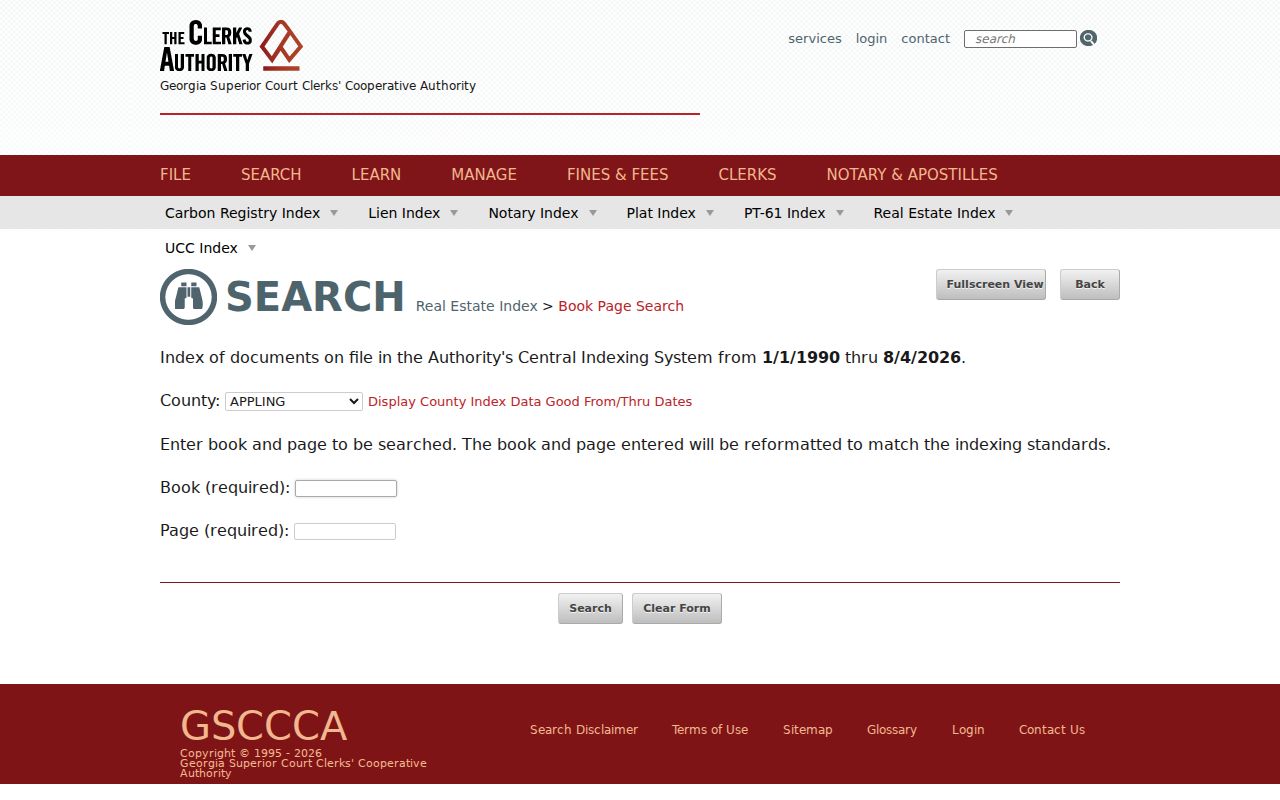
This search works best after another record supplies the book and page. Match the returned instrument's parties, dates, and legal description to the land before trusting it.
Monroe County Deed Party Links
A grantor transfers the stated interest. A grantee receives it. In the GSCCCA name search, keep those roles separate, and test initials, punctuation, entity suffixes, estate language, executor, trustee, and trust forms of a name.
- Start with the QPublic owner display, parcel key, situs, and legal description.
- Find the newest deed naming that party as grantee and matching the land.
- Open the prior-instrument reference or search that party in the grantor role.
- Record type, dates, parties, citation, plat references, and legal text for each link.
- Repeat while reconciling splits, old addresses, entities, and estates.
- Grantor
- The party conveying the interest described in an instrument.
- Grantee
- The party receiving that interest.
- Chain of title
- The linked sequence of conveyances affecting the same land.
- Book and page
- The filing citation used to retrieve a recorded document.
Names alone make unsafe links between deeds. Reconcile parcel, land lot, district, subdivision, acreage, and prior references too. A business registry can clarify an entity's identity, though it proves nothing about title.
Monroe County Deed Index Clue
GSCCCA's live page reports a range. The central system holds documents from January 1, 1990 through August 4, 2026. That is a statewide statement. It does not prove every Monroe County category starts on that date. Check the selected index's own good-from and through dates instead. When a chain runs older than web coverage, ask the Clerk about the right book, the public terminal, the original, or microfilm. The Georgia Archives guide notes that county deeds may sit on microfilm. Original custody stays with Superior Court.
Coverage limit. Monroe County's own earliest searchable deed year was not verified. Treat 1990 as a central-index clue, not a local guarantee.
Plats Repair Monroe County Deed Chains
A Culloden notice for 663 Abercrombie Road cites a 1999 survey in Plat Book 23, page 46. It also lists deed references in Volumes 963, 922, and 868, plus tax ID 033-015B. Treat the notice as an index lead, not a certified deed. Forsyth notices tie Willis Heights and North Willis Heights Estates to lots, sections, land lots, and plat books. Another connects a 1946 subdivision plat to a street now called Sunset Terrace. Clues like these bridge a changed parcel key or street number. The recorded legal geography persists underneath. Search the newspaper OCR. Compare it against the scan, then open the Clerk record. OCR misreads names and figures.
Side Instruments in Deed Records
A chain file can hold easements, restrictions, security deeds, assignments, liens, releases, satisfactions, lis pendens, and plats. None of them is a fee-title conveyance. It does not become one just because it sits beside the parcel or party. Search liens and releases separately. A lien entry does not establish that it remains open. Parcel splits can also break a simple chain. Follow the legal description and plat whenever the assessor key changes.
FANS Watches New Monroe Filings
Georgia's Filing Activity Notification System can alert an enrolled user when a filing indexes a selected name. FANS is free and forward-looking. It is not a historical deed search, and it is not complete title monitoring. An alert is a reason to inspect the new instrument, not proof of fraud or a valid transfer. Enroll the exact personal, trust, and entity name forms that matter.
Historical Channels Beyond GSCCCA
When the online index runs dry, older channels still work. Start at the Monroe County Clerk's public terminal and deed books. Work from the last solid book and page you have. Also gather any prior-instrument citation, legal description, subdivision, land lot, district, or party name. Ask staff which volumes sit in the courthouse. Ask too whether a book survives as an original, an image, or microfilm. A precise request built on an existing citation beats a street-address request for an early deed every time.
The Georgia Archives points to another route. County deeds often exist on microfilm or as research copies. Original custody generally stays with the Superior Court. The Archives tax-digest guide adds a parallel trail. Many pre-1871 tax records survive on microfilm, and the statewide holdings described for 1872 through 2002 run nearly complete. Digests are usually arranged by militia district or tax district rather than a modern street. They can name heirs or executors and point toward a deed. A taxpayer entry is still not a conveyance.
Local collections translate old geography. The Monroe County Historical Society keeps property files arranged through assessor listings. It also holds an original land-lot map and Forsyth Sanborn maps from 1885 through 1920. The Monroe County Library offers public computers, GALILEO, Ancestry, and newspaper research. The Old Monroe Advertiser collection spans 1856 through 1974, and the Monroe County Reporter begins in 1972. Search notices by party, road, land lot, plat book, deed volume, administrator, executor, or estate.
Every lead should circle back to the Clerk's chain. Newspaper OCR can hand you a citation while garbling a name or number. A Sanborn label may mark a structure or old street pattern, but it cannot fix a modern parcel boundary. A tax digest ties a taxpayer to land administration for one year without proving a complete interest. Write down what each source actually says. Then confirm the transfer in the matching deed book and legal description.
A good courthouse worksheet also leaves room for later instruments. Once a deed turns up, run the same names and land clues forward. Look for a corrective deed, assignment, easement, lien, cancellation, release, or later conveyance. Note whether you viewed an image and whether the copy is certified. That habit preserves an important difference. It separates an index hit, the recorded text, and the legal conclusion someone may eventually need.
Obtain a Monroe County Deed
Start online or at the free courthouse terminal. With an exact citation, ask the Clerk how to receive a plain or certified copy in person or through its accepted request route. An online image and a certified local copy are different products.
The fee sheet revised July 1, 2024 lists $25 to record deeds and real-estate instruments, $25 for cancellations, satisfactions, releases, and assignments, and $10 for plats and maps. These are recording charges, not a quoted certified-copy fee. Confirm current image and copy rates before paying.
Recorded, not guaranteed. Monroe County deed records show filed instruments, not a title opinion. Unrecorded interests or defects may require professional title work.
The former owners search moves backward through a chain of transfers. It does not chase a single instrument.
A careful copy request names Monroe County, the instrument type, party names, recording date, and the exact book and page. Give staff enough detail to locate an existing record. But do not ask the office to build a title report. If the citation came from a newspaper notice or assessor card, say so. Keep the access date. For mail or remote service, confirm the accepted request format, payment method, return method, and certification wording with the Clerk before sending funds.
Keep the index entry beside the document image. The entry shows how the filing was cataloged. The image supplies the operative language, signatures, capacity, legal description, prior deed reference, and any attached exhibit. When those details conflict with the assessment parcel, note the conflict. Seek custodian or professional review rather than picking whichever version looks convenient.