
Monroe County's Owner Record Card
Monroe County's assessment work runs through the Tax Assessor's QPublic parcel card. It is the first present-tense source. The owner field there is the county's current listing. Copy every suffix, initial, trustee term, and entity ending without trimming. Field labels on the live card vary. So resist renaming the entry "legal owner." The card is an assessment record, not a title certificate.
| Owner field | Tax-roll name, copied exactly as displayed |
|---|---|
| Mailing address | Destination for assessment and tax correspondence |
| Situs address | Street location assigned to the parcel |
| Map and parcel | Search key connecting the card to other files |
| Legal description | Land description to compare with the recorded deed |
| Sale reference | Possible bridge to a conveyance, if displayed |
The mailing address routes tax correspondence. The situs address only locates the parcel. Neither proves who lives there, and a trust or company may even list an agent's address for notices.
Check Monroe County Current Owner Data
Start at the official Monroe QPublic endpoint and enter the situs address. Exact strings often fail, so try the street number alone, directional variants, and suffix forms like Rd versus Road. A parcel identifier from a deed, tax bill, survey, zoning file, or legal notice is a stronger second key. Keep the hyphens, spaces, and leading zeros.
Once the parcel opens, record the owner name, mailing address, situs, parcel number, legal description, assessment year, values, exemptions, and sale reference only when those fields appear. Note your access date too. The county publishes no fixed QPublic refresh schedule. There is no annual freeze date or promised lag after closing either.
The official Monroe assessor gateway itself returns no parcel. It names QPublic as the parcel-record route.
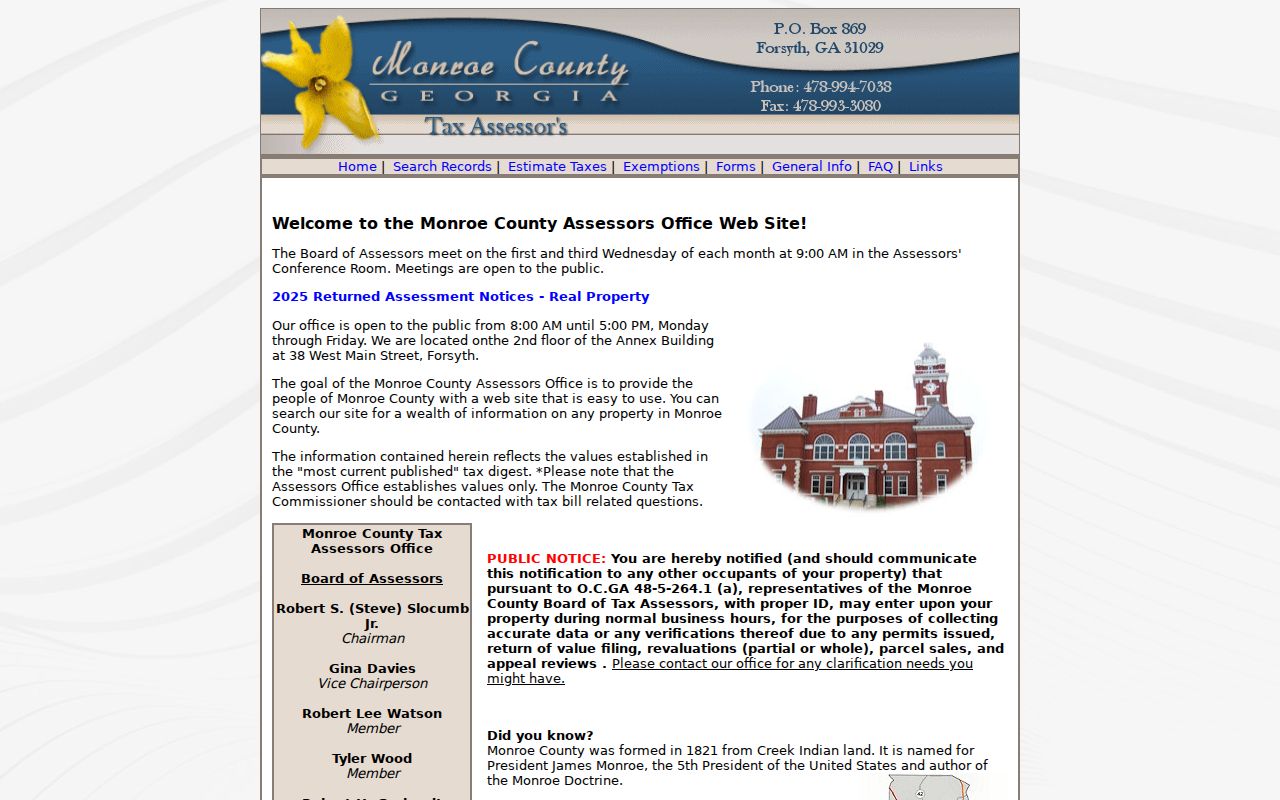
That landing page is not a parcel result. It simply directs the search to the official system behind the tax-roll owner display.
Confirm Monroe County's Current Owner
The assessor's name is only a lead. The latest recorded deed is the stronger conveyance record. Search Monroe County Clerk of Superior Court records through GSCCCA and confirm the newest instrument actually transfers the same land. An easement, security deed, lien, release, or assignment can postdate it without changing fee ownership.
- Copy the QPublic owner field and map-and-parcel identifier exactly.
- Search that name in the GSCCCA Real Estate index as a grantee.
- Open the newest relevant conveyance and compare its legal description.
- Read party capacity, execution date, recording date, and prior deed citation.
- Ask the Assessor or Clerk to explain a mismatch.
- Owner of record
- The party named in the relevant official roll or recorded instrument, with the source stated.
- Vesting
- The wording that describes how a deed places title in the grantee.
- Registered agent
- The listed recipient for an entity's legal notices, not necessarily its owner or occupant.
The GSCCCA index offers several search paths, but access level matters. Courthouse terminals are free during regular Clerk hours. A regular subscription and a premium tier add expanded image, export, and street-address functions. A printed page runs fifty cents. Those charges concern access and printing rather than certification. When a filing, estate matter, boundary dispute, or title opinion depends on proof of ownership, ask the Clerk which copy form the office accepts.
A known book and page goes into the Real Estate search with Monroe selected as the county. Preserve the grantee's entity suffix in a name search. Try reasonable variants too. The central index states a January 1, 1990 starting point. That date is an access clue only. It is not proof that older deed-book references are absent.
How Current Is Monroe County.s Owner
Monroe's Tax Commissioner bills the January 1 owner. A parcel that sells later can still show the earlier owner on the bill. The county directs buyers and sellers to contact the office about post-January transactions. That rule governs billing, not QPublic's update timing.
Recent-sale gap. A deed can be recorded before the new name appears on a tax bill; compare dates and ask the custodian about the roll.
A current digest reflects the latest assessment cycle. It is not live title status. Compare the deed's recording date with the card's tax year and your access date. The Clerk handles recorded instruments, the Assessor explains its owner field, and the Tax Commissioner covers the billing name.
Monroe County Current Entity Owners
An LLC, corporation, estate, trust, or trustee can be the displayed current owner. Never swap the suffix for a seemingly connected person. Georgia companies can be searched through the Secretary of State business search. Searches run by business name or control number. Results may show the entity's status, registered agent, officers, and designated agent where supplied.
Those fields help separate similarly named companies and give an official contact path. They do not list every tract owned. A registered agent does not become the owner by receiving notices. Trust and estate terms deserve the same care as company suffixes. A trustee signs in a stated capacity. An executor or administrator may act for an estate.
When an entity name differs between QPublic and the deed, compare punctuation, abbreviations, mergers, and recording dates. Only then call them different parties. Search the exact deed grantee first, then the tax-roll spelling. Match company results by control number when possible. A probate appointment alone does not convey the parcel. The Monroe Probate Court file may still explain who holds authority. The recorded instrument remains the ownership bridge.
Permits Do Not Reset Ownership
A Monroe building application says a permit triggers a Tax Assessor inspection. New improvement facts may then land in the parcel data. But no permit makes the applicant, builder, or contractor the current owner. Forsyth zoning and land-disturbance forms add their own wrinkles. Each one can name an owner, an agent, and an applicant. Those roles must never be blurred together.
That local quirk is why a brand-new permit can sit beside an older parcel card. Read permit records for what they actually cover. That means work done, zoning questions, or a pending site change. To verify ownership, rely on the tax-roll owner field. Pair it with the latest deed in the deed records. A map amendment shifts land-use context only. It conveys no title.
Monroe Owner Records Offline
If QPublic or GSCCCA returns nothing usable, the search is far from over. The Tax Assessor sits at 38 W Main Street, second floor Annex, in Forsyth. The office lists 478-994-7038 with weekday hours of 8 a.m. to 5 p.m. Bring a situs address, the parcel number, and a record date. The Clerk of Superior Court works from 1 Courthouse Square and answers at 478-994-7022.
GSCCCA also reports free public terminals in each county Clerk's office during regular hours. Terminals make a solid fallback when online address search or images demand an account. A premium account unlocks street-address and image functions. Yet a web image and a terminal result are both uncertified. Ask the Clerk which copy you need.
A written Georgia Open Records Act request is another path to agency records missing from a portal. It stays subject to exemptions and lawful redaction. Keep it narrow: one parcel, one document type, one date range. The Act never forces an office to build a new ownership report. Nor does it require one to reach a legal conclusion. For assessor questions, a quick call or counter visit usually beats a broad records request.
Contact a Monroe Property Owner
The tax-roll mailing address is the best public-record clue for mailing a property-specific letter. State the parcel or address and the lawful reason for contact. Be careful with assumptions. The mailing address may not be a home. The named party may not occupy the site. A shared family name proves nothing about identity.
Lawful use. Public owner information may support a property inquiry, but it must never be used to stalk, harass, threaten, or harm anyone.
Public access does not license republishing every personal detail. Georgia's Open Records Act governs agency access, while specific laws and redactions shield certain data. For the wider address-to-owner route, see how to identify a Monroe County property owner.